Peter's Travel Tips
Travelling with a Cochlear Implant (CI)
Peter has worked in aviation and airports all of his working life, both in the UK and overseas. This includes 5 years with the International Civil Aviation Authority and nearly 2 years with the European Union Aviation Safety Agency, as well as with several Civil Aviation Authorities. Most of his working life, he has had single sided sensorineural hearing loss, but in 2019 lost the hearing in his good ear and was implanted in 2020. Now he uses a Cochlear Kanso 3 sound processor bimodally with a Danalogic Ambio S88 hearing aid. These are paired with his iPhone running iOS26.
You should always check with either your Cochlear Implant centre or your manufacturer for guidance that is specific to your own hearing hearing instruments, but it is hoped that you will find Peter’s experiences useful.
Made for iPhone
When implanted in 2020, I used an Android smartphone, and was very happy with it. Once I heard about Made for iPhone (MFI), I made further enquiries and changed to iPhone in 2022. Both hearing instruments are controlled by my iPhone in its internal settings. Although I do have both Apps on my iPhone, Cochlear’s Nucleus Smart App and GN/Danalogic’s BeMore, I control both the sound processor and hearing aid in my iPhone’s settings. I stream mobile phone calls, TV, and laptop to both ears via my iPhone. This is important for quite a few travelling scenarios.
Cochlear mini mic
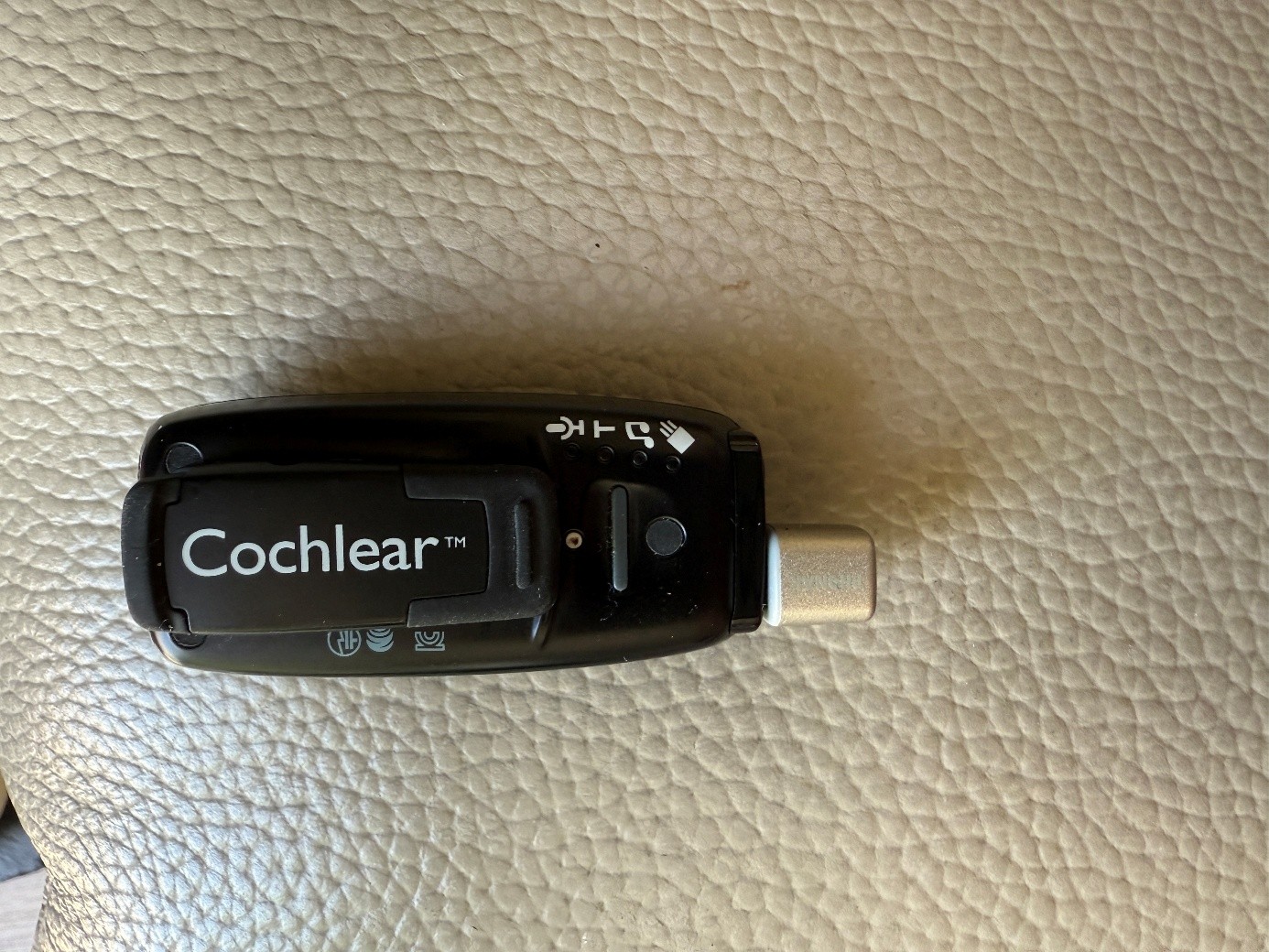
The Cochlear mini mic is my link to connecting by both Bluetooth, Telecoil, and by audio cable. It has 4 settings on the bottom rear: microphone, Telecoil, wired connection, and FM. The FM connection is via the small silver coloured connection (Roger X) at the bottom, and I use that to connect to my Roger On pen or Roger table microphones
Travelling accessories
For travelling with my CI, I have a pack with essential accessories. When flying, I take this pack out of my carry-on bag and keep it with me at my seat so that everything is to hand.
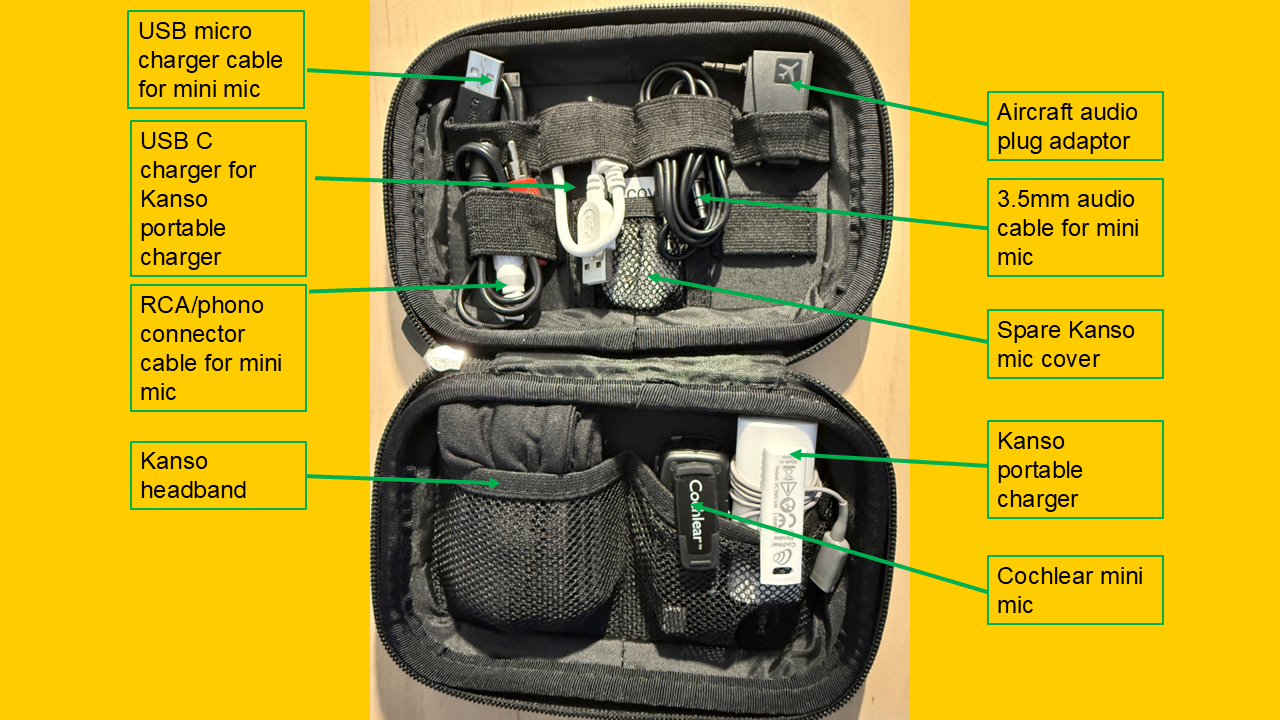
Seat travel pack for Kanso 3
Planning
Whatever trip you are embarking on, I cannot recommend strongly enough to plan well ahead. Some of these actions are explored in more detail:
- Research your airline / train / bus / ship operator to see how you can pre-notify them of your hearing loss, and if necessary, pre-book assistance or an assistive hearing device.
- Check with your manufacturer about ordering a spare sound processor to take with you.
- Check that you have spares for your sound processor such as disposable batteries, microphone covers, coil, ear hook, etc.
- If you are going to be using your CI aqua kit for the first time, practice at home.
- Check any headbands or hats that you plan to use fit comfortably with your coil or off ear sound processor in place securely.
- Do not worry, and look forward to enjoying your trip.
- If you don’t already have one, get a lanyard that you are happy to wear. I recommend the sunflower lanyard, with a badge using the wording that you are comfortable with, such as I am deaf, or I have hearing loss. Also get a lanyard and badge for your travelling companion as illustrated.
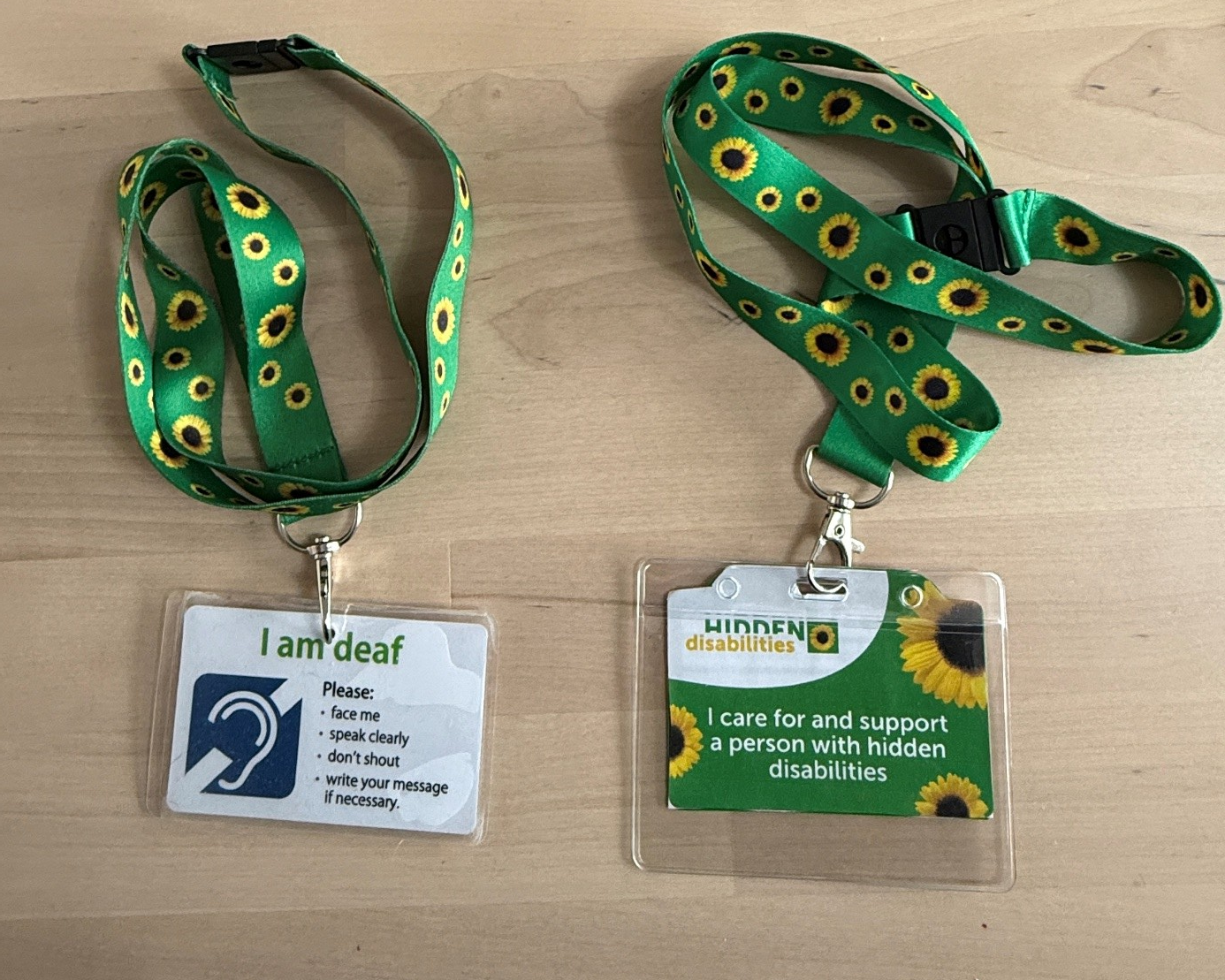
Mr and Mrs Sunflower lanyards and badges
Airport Security
Check the website of your CI manufacturer for the latest information about passing through security. You can also contact your CI centre who can give you up to date advice. The following is based on my experience since being implanted in 2020 and passing through airport security as both a passenger and as temporary airport staff, both in the UK and overseas, implanted with a Cochlear implant in 2020, and since 2025 wearing a Kanso 3. It equally applies when I wore a Nucleus 7 and Kanso 2, as well as a Danalogic hearing aid. It agrees with the advice on Cochlear.com at the time of writing. My aim is to be able to pass through security as normally as possible with the minimum inconvenience.
- Wear your lanyard and badge from before you approach security, for their benefit as much as yours.
- I never remove my hearing aid or Cochlear sound processor and have never alarmed either the archway metal director (the older walkthrough) or the whole body scanner (the newer larger arch where you stand still whilst being scanned). I always wear my sunflower lanyard with a badge from hearing link.
- Place all of your spares and support equipment for your hearing devices in your carry on luggage. If that takes the bag over the airline’s weight limit, check with the airline in advance if they allow you an extra allowance for medical equipment. I have never had a problem with this, and can easily have several kilos of power supplies, cables, dehumidifier, charger, spares etc.
- Before the luggage x-ray remove everything from your pockets, watch, jewellery, belt, even tissues from your pocket, and (if instructed by the security officer) your shoes. Here, your aim is to not alarm the body scanner for any reason. Approach the body screening with completely empty pockets and wearing your lanyard and badge.
- Some cochlear implant sources advise to remove the sound processor in case it alarms the security equipment, I recommend leaving it in place on your ear/head, because:
- It is not a problem if you do alarm the detector, and you can explain that you have an implanted device, although I have never had to show my device registration card. The card should be in your carry on luggage. It will not be with you when you alarm the scanner because you have to empty your pockets.
- You want to be able to hear what the security officer is saying to you.
- You do not want the sound processor to go through the X-ray on the belt due to the static electricity risk.
- However, if you are advised to remove it please always follow the instructions of the security staff (it may differ in different airports).
If you are directed to go through a modern whole body scanner where you stand with your arms apart until told you continue, then take your lanyard off as you approach the scanner and pass it to the attending security officer, otherwise that may show up on the scan as an anomaly.
Power Planning
Getting up at 5am or earlier to travel to an airport for an early flight, bus or train, then making a connection to another flight can test your usual daily power regime for your sound processor. So, plan ahead taking spare charged or disposable batteries, and a battery charger with USB cable and plug with adaptors appropriate to your country of destination. Fortunately, Cochlear, for example, provide UK, US and Europe type plug adaptors for its chargers. There are some countries that are different, such as Switzerland, India and South Africa.
If you are charging your batteries or sound processor onboard an aircraft, then you must disconnect that charging for take-off and landing, and when you leave your seat.
My longest day wearing my rechargeable Kanso 3 started at 7am and involved a full day’s work, then an evening check in for an overnight 14 hour flight, followed by two connecting flights of 2 hours then 1 ½ hours, the second of which was delayed by 3 hours to get back to Edinburgh from Hong Kong, and then a 2 hour drive. I started the work day fully charged, wore my Kanso 3 throughout my time in the airport that evening but charged it on my head with my portable charger, illustrated. Then recharged that portable charger, removed the Kanso for about 5 hours overnight and put it on charge, then recharged it whilst wearing it again at Heathrow between the two connecting flights.
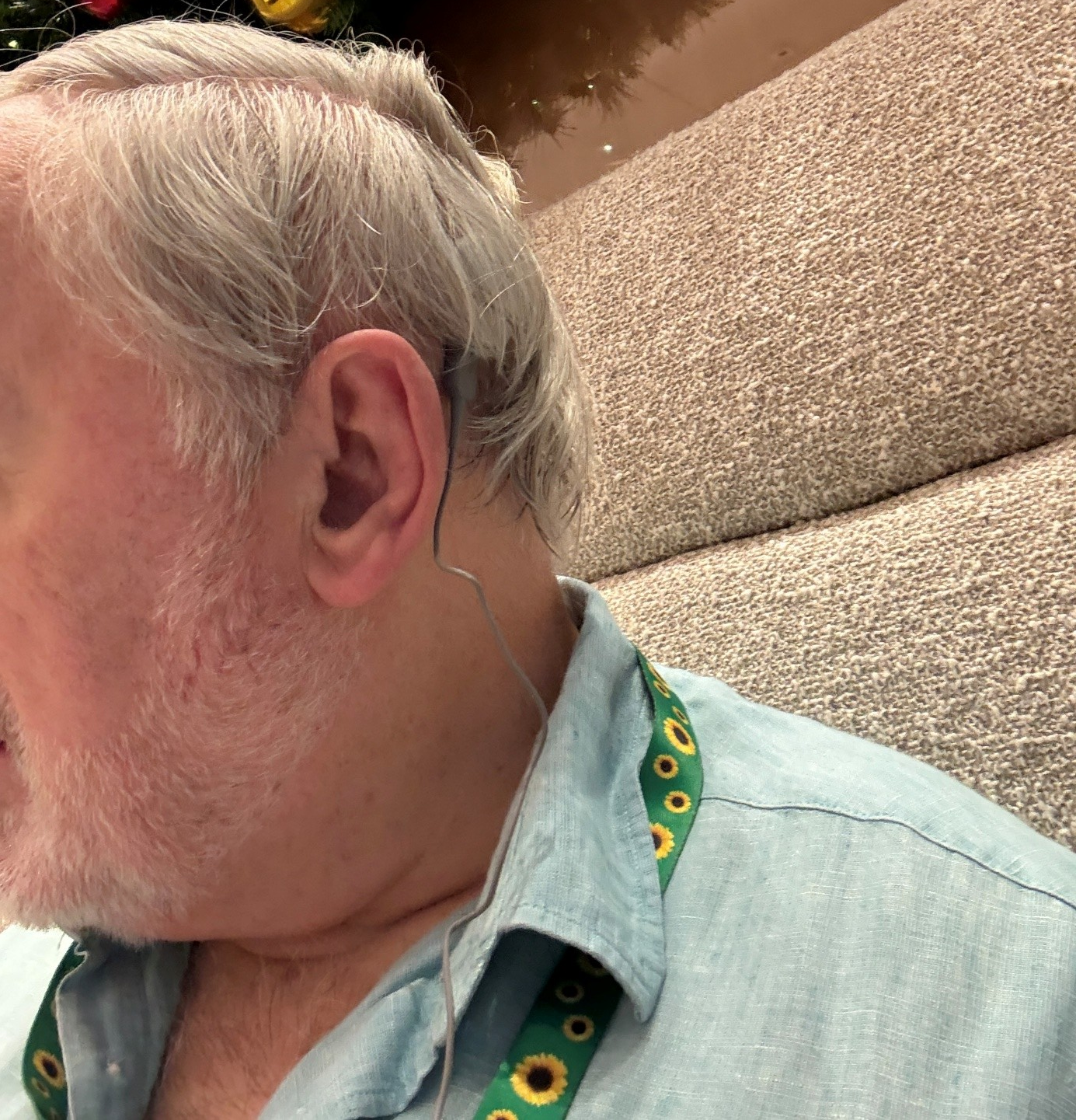
Kanso 3 on charge whilst in use
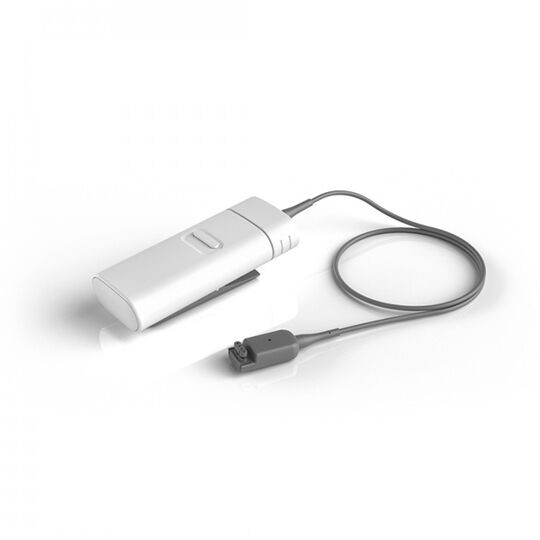
Kanso portable charger
I do not carry a power bank any more, but if you plan to take one, ensure that you buy a reputable make and that its capacity does not exceed the limits on board your flight or cruise ship. USB power, and even mains power, is now so freely available everywhere that I no longer have any use for a powerbank. Powerbank do carry a risk of fire and damage. The following illustration is of a power bank that had been in the top of my wardrobe for a couple of months, not in direct sunlight.
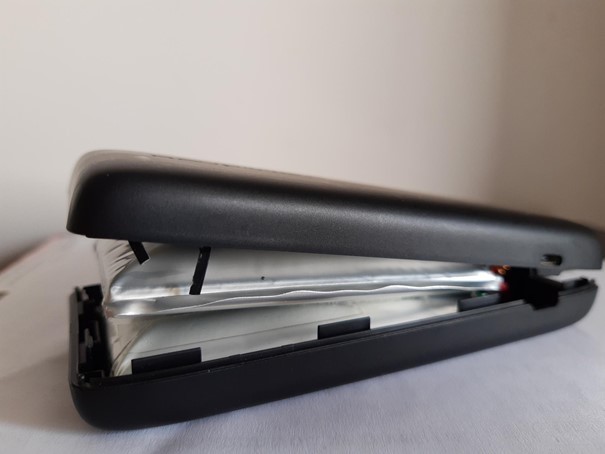
An expanding powerbank (lithium cells have expanded to break open the casing)
Flying
As already mentioned, plan in advance for whatever assistance you require. As a minimum it should involve notifying the airline of your hearing loss. This will then be included in your passenger name record, and will be annotated against your name on the manifest that the flight crew have onboard the aircraft. Some airlines will print the IATA code for hearing loss or deafness on your boarding pass.
You may prefer the full escort through the airport, in which case on arrival at the airport you report to the PRM or Assistance desk before going to check in. PRM is the European term for passengers requiring any form of assistance and stands for passengers with reduced mobility. The worldwide term is PWD, persons with disability. Relax, and do not take offense at being labelled deaf, when you can hear with your CI, or as being of reduced mobility. Also, if you have asked for assistance, you may be taken through the airport in a wheelchair. Enjoy the pampering, but do not be nervous about saying that you need refreshment, or shopping, or the toilet.
Most airlines will allow you to pre-board, even if you have not asked for assistance, just make yourself known to the gate staff when you get there. This means that you can board before most other passengers and will not be bothered by others asking to get past you as you stow your luggage. The cabin attendant might ask what level of hearing loss you have? Remember to say that if you take off your sound processor for a rest, or for charging, you will not hear anything.
Except for the most modern aircraft, it is likely that you will not be able to understand everything in the passenger safety briefing, so you have a few options including reading the safety card in your seat pocket, and actually looking where your nearest exits are. The cabin crew might offer you a personal safety briefing.
If your smartphone has an offline live captions function, such as iPhone, shown below, then you can use that to help understand announcements and briefings. This was where you realise that, particularly on older aircraft, if your phone cannot understand what the crew are saying, then probably most other hearing passengers also cannot understand every word!
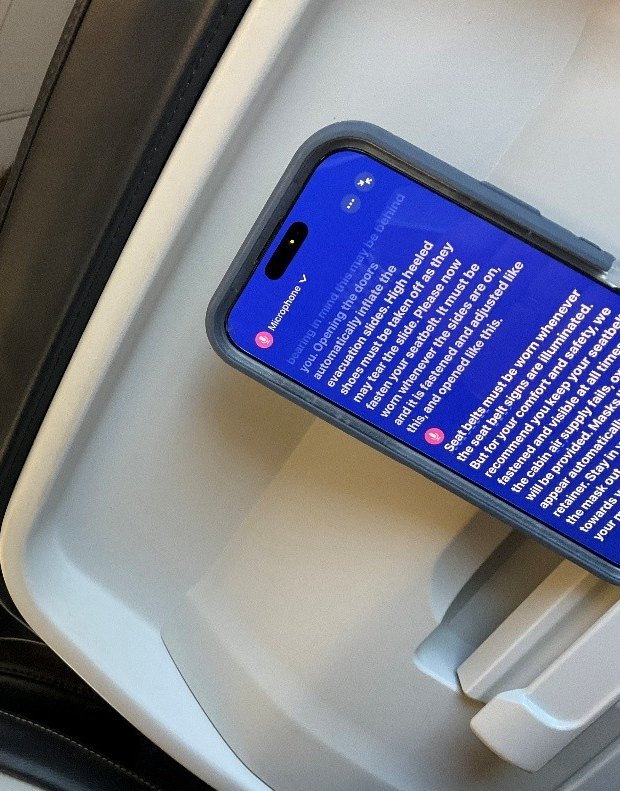
Accurate offline captions (iOS26)
Your phone must be in flight mode, and as soon as the safety demonstration is finished you must stow the phone/tablet holder shown for take-off, and either hold your phone or put it in your bag or pocket. I use live captions to follow the safety demonstration.
I keep my lanyard and badge on until the cabin attendant who will be looking after you has seen you. You may have difficulty understanding any questions in flight due to the noise and distractions, so you might use live captions again, or ask the attendant to write what they are saying. I have even had a cabin attendant show me the two meals that I could choose from.
If you are arriving at an airport for the first time, then you might have asked for assistance. Again, if this involves a wheelchair, go with it, and enjoy the speedy immigration process. If not assisted, wear you lanyard at immigration and customs.
NEVER ASSUME THAT YOU HAVE HEARD WHAT AN OFFICIAL HAS SAID, IF IT WAS NOT CLEAR, always mention your hearing loss/deafness and say that you do not understand.
Loan Sound Processor
When travelling outside the UK, I strongly recommend that you contact your manufacturer more than 14 days in advance to order a holiday loaner sound processor. They will programme the same type of processor that you have after obtaining your latest mapping from your centre, and mail it to you before departure. There is a charge for this service depending on the length of time that you need the spare for. The loaner is provided sealed in a box, and should not be opened unless it is needed. Only the processor is provided, so you will need to have spare mic covers, battery, coil, ear hook, etc as appropriate to your device. When you return home, you simply send it back in the packaging provided using tracked mail. I have always done this, and have never needed it, but I do appreciate the peace of mind.
Hot and Humid
When travelling to hot climates, particularly hot and humid climates, you should take precautions to protect your sound processor from the heat, and humidity.

Trekking for gorillas in Bwindi Wildlife Park, Uganda
That protection might take the form of wearing a hat to protect your sound processor from direct sunlight, and/or inserting the sound processor, and hearing aid, if you have one, into a protecting cover. Your centre might have these covers, or they can be ordered directly from the manufacturer at gearforears.com. You can get the covers with or without a safety line to clip to your clothing, and can order a pair of covers suitable for your own devices, such as a Kanso/Rondo on one side, and a Danalogic hearing aid on the other, attached to one clip. Covers with a safety line for bilateral implants are illustrated. Alternatively, you could ask your centre or manufacturer for a headband suitable for your processor. As a last resort, perhaps, in really wet conditions, such as illustrated above in a rain forest, you might consider using your aqua pack to protect your sound processor. In that photo, I was wearing the ear gear covers below clipped to my shirt.
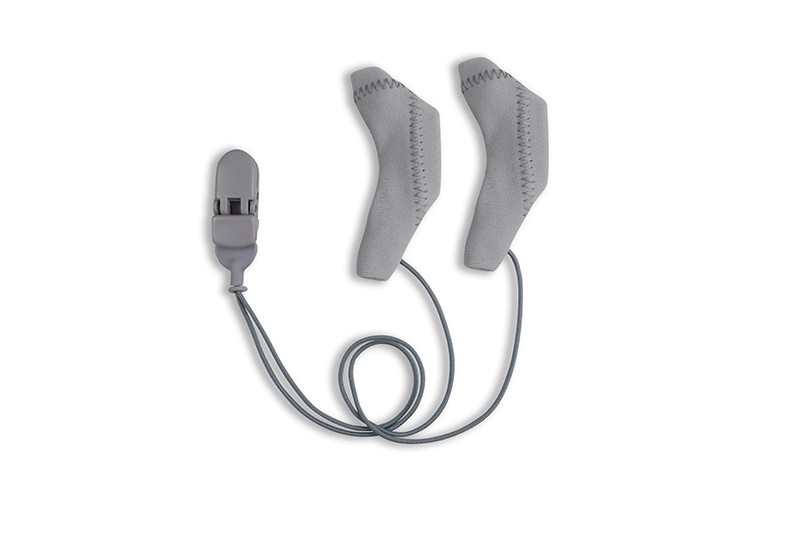
Ear gear Cochlear Nucleus covers with safety line
The kit that came with your sound processor will include a de-humidifier. For some processors, such as the Cochlear Kanso it is a combined charger and dehumidifier. This should be used every night whilst you are sleeping. You can buy a portable USB powered de-humidifier or just use a plastic container with small cartridge, all shown.
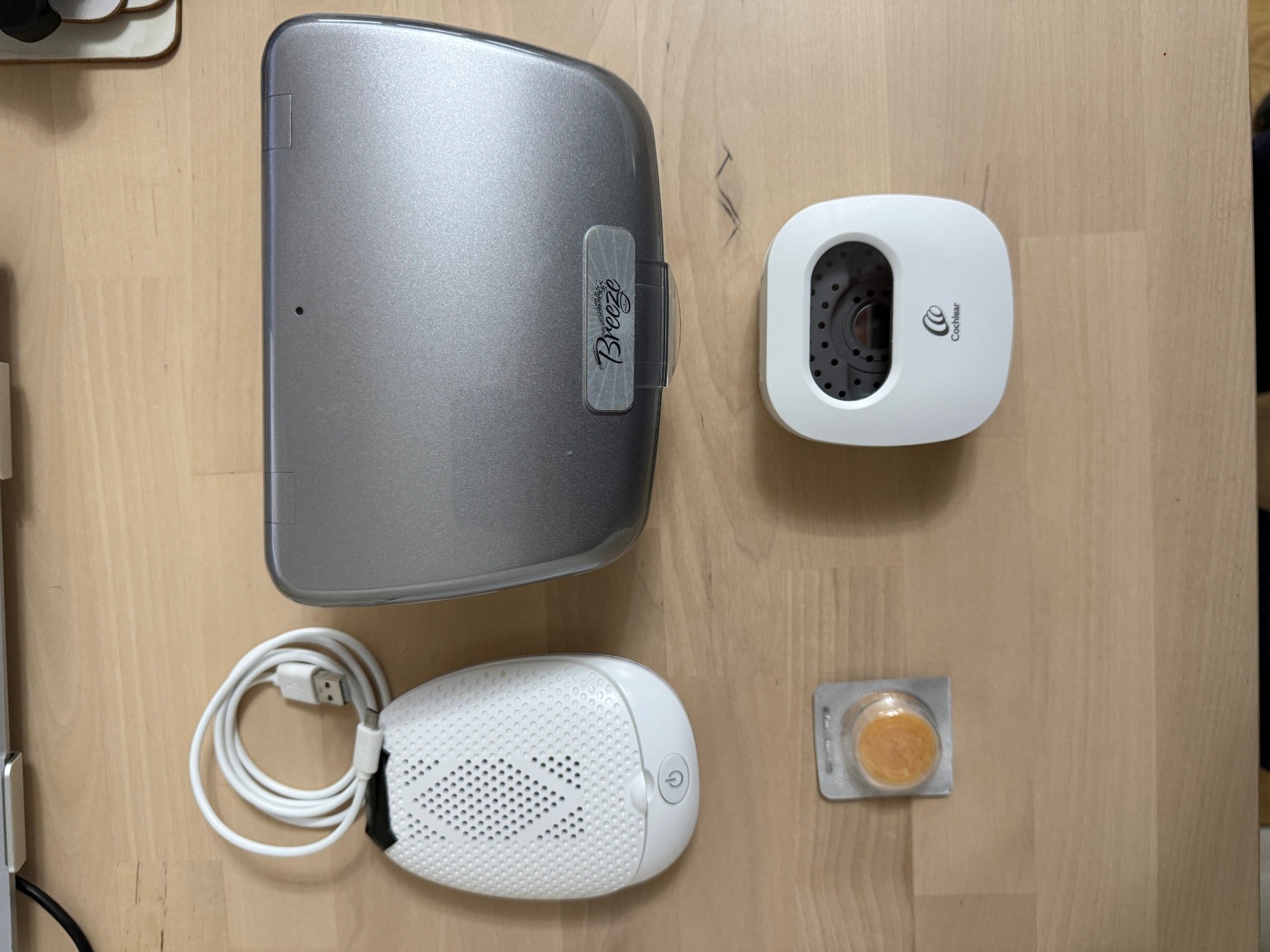
De-humidifiers, clockwise: portable USB drier, Breeze mains powered, Cochlear Kanso charger and de-humidifier, drying capsule.
Driving
When driving, there is a possibility of an accident, or illness that leaves you unconscious. Therefore, it is useful to have an indication for emergency responders that you may not respond to voice, and, in the case of an implant, have restrictions on MRIs according to the actual implant that is installed. This is particularly important for older implants that might not be MRI compatible. A standard seat belt sleeve is illustrated. You can find bespoke sleeves on Amazon. This will also grab the attention if you should be stopped for a road traffic offence. In the latter case, you should politely inform the police officer that they need to be on the same side as your processor, by either coming around to the other side of the car or by you getting into the police car. If this happens overseas, stay in your car with your hands on the wheel until you have opened a dialogue with the police officer.
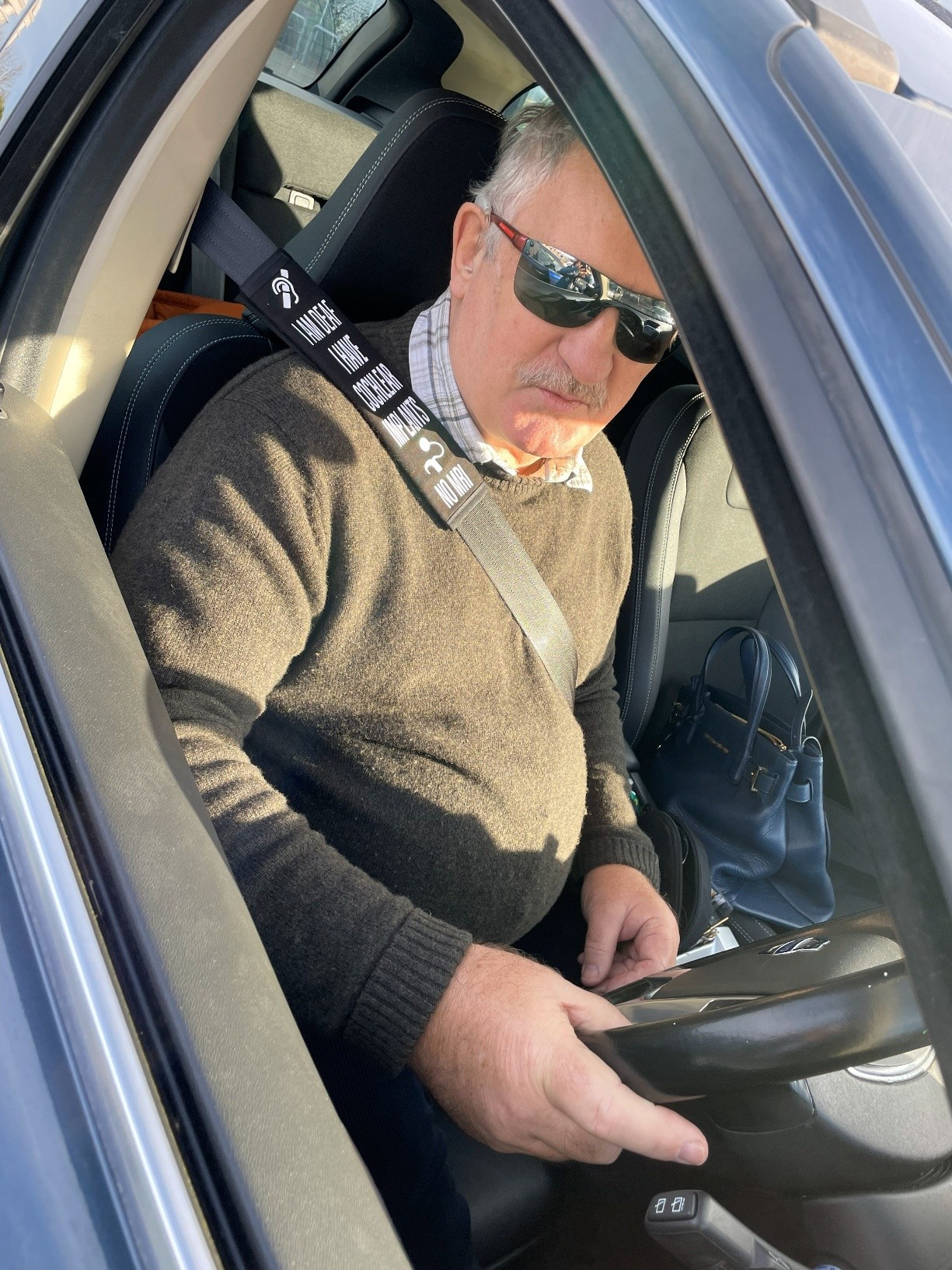
Seat belt sleeve for Cochlear implant wearers
If you will be driving in England then you might like to order a free sunflower sticker or magnetic disc for the rear of your car. This indicates that the driver, or someone in the car has a hidden disability.
Bus
Before you board a Stagecoach bus, switch on your hearing loop/T coil setting, as most Stagecoach busses have a hearing loop at the driver’s seat.
If taking a tour bus where they provide headsets for the tour commentary, you can plug your mini mic into the headset socket using the 3.5mm jack plug lead that is provided with the mini mic and then stream to your Cochlear sound processor and hearing aid.
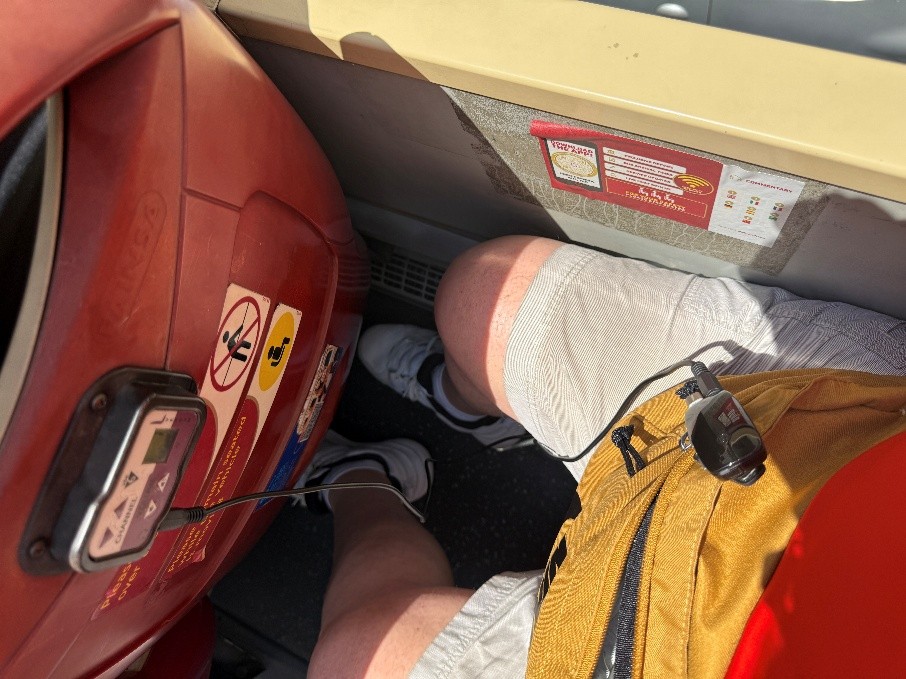
Mini mic streaming on a tour bus
Train
Rail stations and trains can be a challenge for anyone with a hearing loss. Before travelling check the train operator’s website for accessibility assistance, and for facilities that might help you, including the operator’s smartphone App, and whether their help points have Telecoils. You may be able to book assistance to get someone to help you to get the correct train on the correct platform, or some operators have an App that gives you station maps and guides, and real time information, and may even repeat as text any train announcements, e.g. Swiss train operator SBB.
Hotel
Notify the hotel in advance that you may not be able to hear a fire alarm, and they may be able to provide a Deafgard device. You can also buy your own fire alarm repeater with bed shaker and flashing light, both illustrated. When checking in at a hotel, tell reception about your hearing loss and they will also add you to their list of rooms to be physically checked in the event of an alarm.
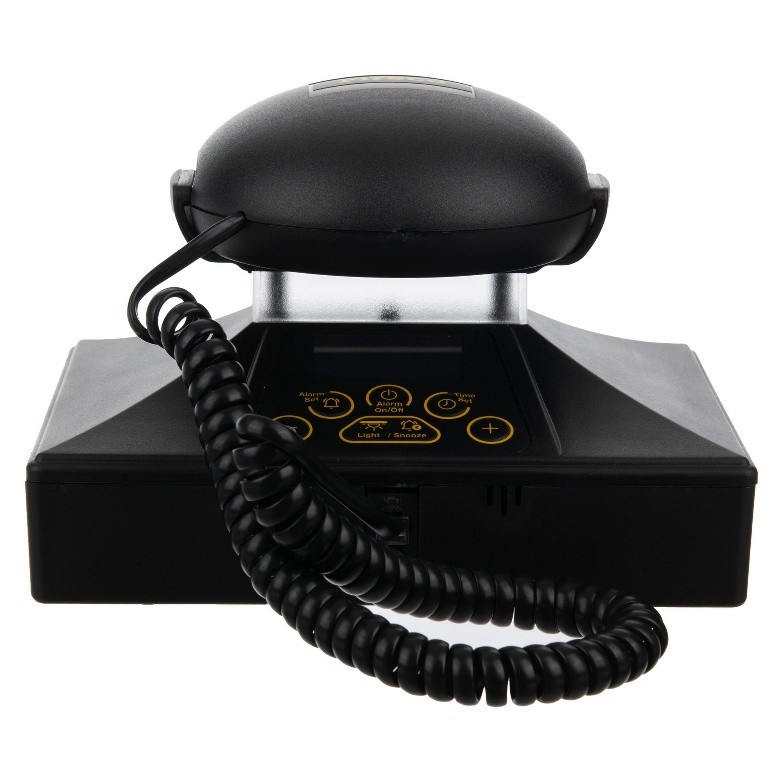
Deafgard fire alarm repeater and pillow shaker
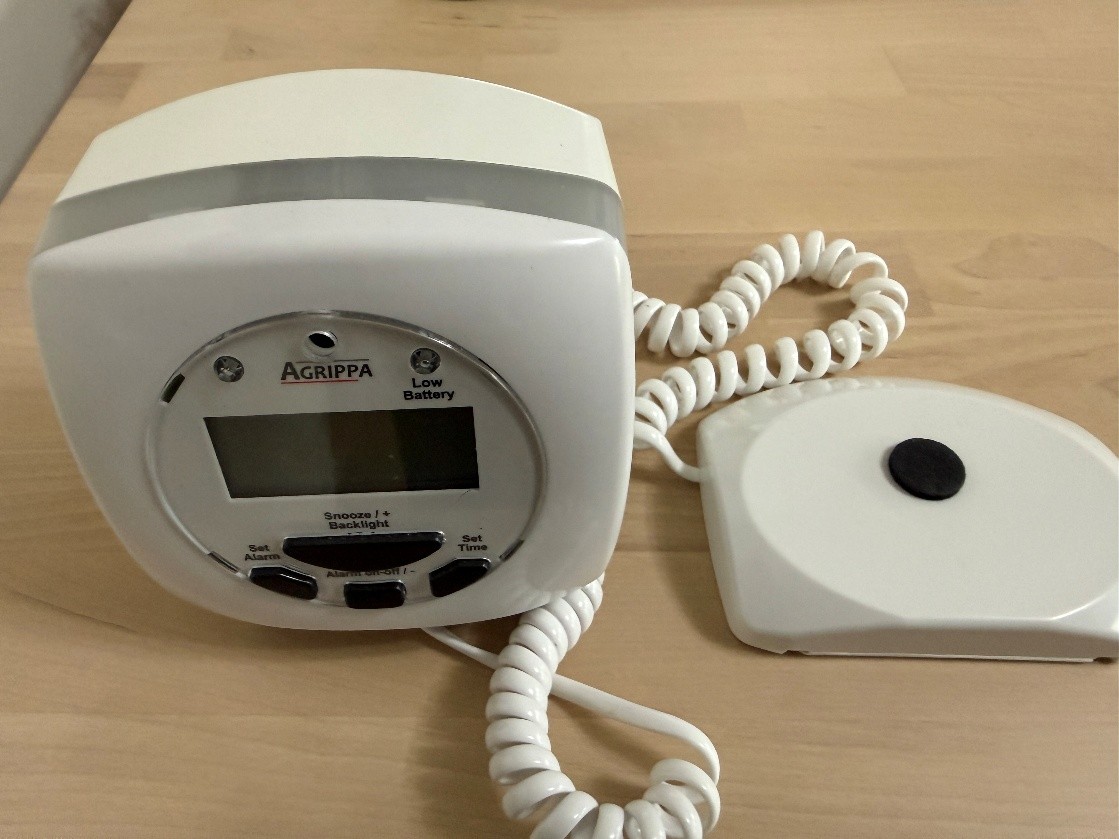
Agrippa fire alarm repeater and pillow shaker
Cruise ship
If going on a cruise, then as with flying, well in advance of the cruise, complete the online accessibility/disability form for the cruise telling them about your hearing loss and implant. Telling them that you have an implant is an important point of detail as we cannot use a headset that that they might otherwise provide, as illustrated. In the ship’s theatre the cruise line should be able to provide you with a device that enables you to connect your processor to the theatre’s sound system, most commonly using a hearing loop. Again, you might connect to that device by plugging in your mini mic to the device, but some devices that are provided with an ear piece are not suitable for that because the ear piece cable is also the antenna for the device. Therefore you cannot simply unplug the ear piece and plug in your mini mic, as the device would lose the signal. Once on a cruise line I had emailed the details of my hearing loss and implant in advance, including making it very clear in both the email and in a follow-up phone call that my ear did not work and that I could not use a headset. When I was given a device with only an ear piece option I realised that I had to make clear to the customer service team that it was of absolutely no use to me. I asked for, and the next day received a different version of the device that allowed me to connect my hearing loop. The ear piece solution was best summarised in discussion, by me asking “would you give a blind man binoculars?” We sometimes have to self advocate in a manner that is neither rude nor aggressive but which brings the point home and cannot be misunderstood. A good solution was found: a Sennheiser device that can be used with either Bluetooth or hearing loop.
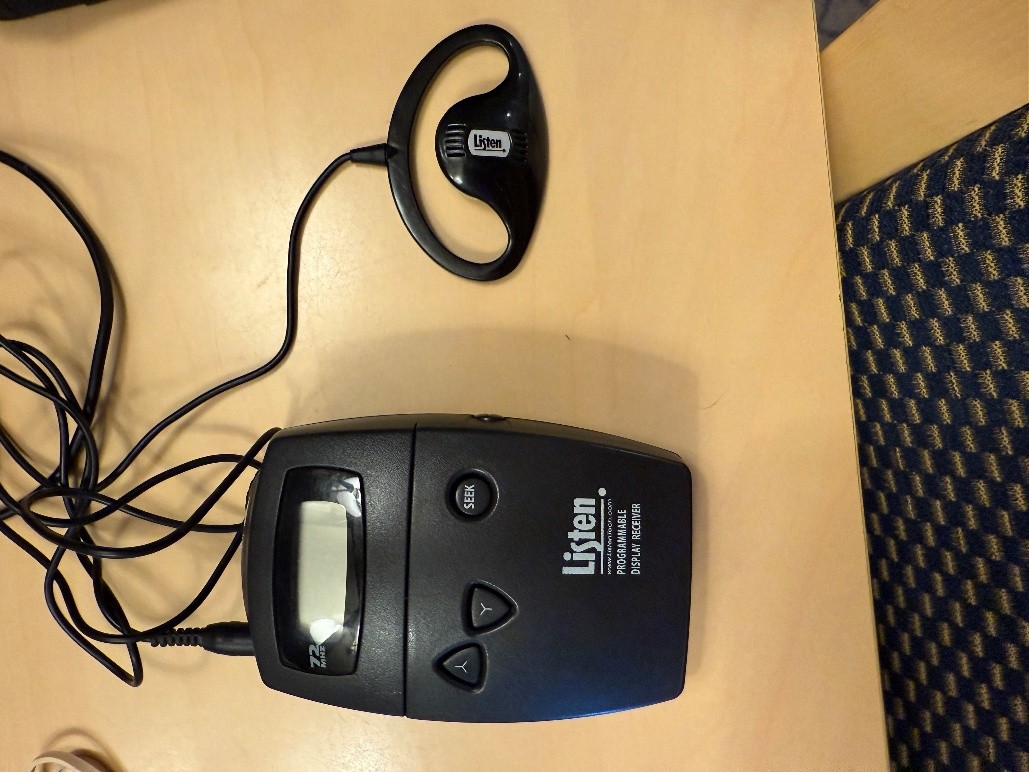
Earpiece unsuitable for a cochlear implant wearer.
Finally

Taking my Kanso, and my long suffering wife, for a stroll up Mt Etna
Happy travels